gcsescience.com 2 gcsescience.com
Water, Carbon and Nitrogen Cycles
The Carbon Cycle.
What is the Carbon Cycle?
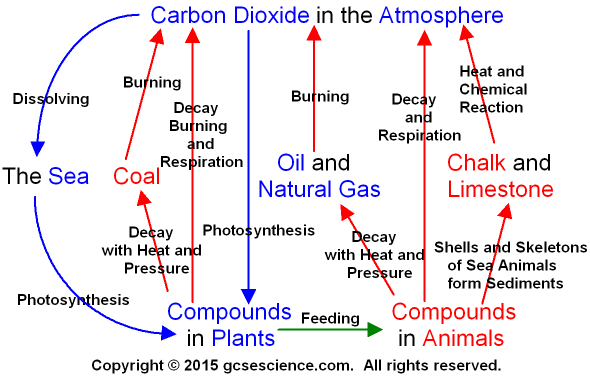
The carbon cycle
describes the movement of carbon
through the environment. Carbon exists in
the ground, in
the sea, in plants and
animals, and in the air.
Carbon
moves
through the processes shown in the picture
below.
How does the Carbon Cycle work?
The natural processes
shown in the picture above can
release carbon
dioxide into the atmosphere
(shown by red arrows) by combustion,
decay and respiration,
or
remove carbon dioxide from the atmosphere
(shown by blue arrows)
by
dissolving in the sea (see below) and by photosynthesis,
or
"lock up" carbon in the ground (shown by green
arrows)
as a fossil fuel or by forming carbonate rocks.
Carbon
dioxide in the atmosphere
dissolves in rain water,
forming carbonic acid (H2CO3(aq)).
H2O(l) + CO2(g)  H+(aq) +
HCO3-(aq)
H+(aq) +
HCO3-(aq)
This makes rain water naturally acidic (pH =
5.5).
This acidic rain
water will react with carbonates in rocks.
Rain
water containing dissolved carbon dioxide
finds its way into the sea (see the water cycle).
Carbon dioxide also dissolves directly
into the
surface of the sea. The huge oceans are
an important
gas
reservoir for carbon dioxide
(they store it).
Chalk
and limestone release carbon dioxide into
the atmosphere when they react with
acid rain.
If chalk or limestone are forced
down into magma
and heated, then carbon dioxide may be
released into the atmosphere from volcanoes.
The burning of
fossil fuels is increasing the amount
of carbon dioxide in the atmosphere faster
than nature
can remove it.
Deforestation (cutting down forests)
is
making this worse, as it reduces the
removal of
carbon dioxide from the atmosphere
by
photosynthesis.
See also global warming and greenhouse gases.
 Links
The Atmosphere
Revision Questions
Links
The Atmosphere
Revision Questions
gcsescience.com The Periodic Table Index Carbon Cycle Quiz gcsescience.com
Home GCSE Chemistry GCSE Physics
Copyright © 2015 gcsescience.com. All Rights Reserved.