gcsescience.com 18 gcsescience.com
What is Reflection?
Any type of wave can be reflected.
We shall look at the reflection of
Sound,
Water and
Light Waves.
Reflection best occurs from
flat, hard surfaces.
After reflection,
a wave has the same
speed,
frequency and
wavelength,
it is only the direction of the
wave that has changed.
For light (and other electromagnetic
radiation)
a flat shiny surface, like a
plane mirror, is a good
reflector.
A plane mirror is one that is
straight and not
curved.
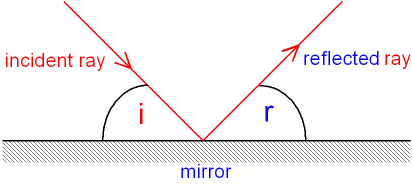
The light
ray that hits the mirror is called the incident ray.
The light ray that bounces off the mirror is called the reflected ray.
The angle of incidence equals the
angle of reflection, i =
r.
This means that whatever angle the
light ray hits the mirror,
it will be reflected off at the
same angle
(like snooker balls bouncing off a cushion).
If the surface of the mirror
is not smooth but rough or
bumpy,
then light will be reflected at many
different angles.
The image in
the mirror will be blurred and unclear.
This is called diffuse reflection (continued).
 Links
Waves
Light
Revision Questions
Links
Waves
Light
Revision Questions
gcsescience.com Physics Quiz Index Light Quiz gcsescience.com
Home GCSE Chemistry GCSE Physics
Copyright © 2015 gcsescience.com. All Rights Reserved.